News regarding Log Inoculation

Soon at Mycelia: Short Plugs for Super Fast Log Inoculation!

For over thirty years, we produce at Mycelia high‑quality mycelium‑inoculated plugs for log cultivation. Our trusted 40 x 8 mm ribbed beechwood plugs — a standard product originally designed for furniture assembly,  served our growers well — but one question kept coming back: “When will you offer the short Japanese‑style plugs?”

Well… the wait is over!

In 2025, we teamed up Natacha and Nathanaël from Ferme des Remblais to put these compact plugs to the test in their Shiitake farm. And the results were impressive. 

In the video below, you’ll see how fast and easy inoculation becomes with a Japanese drill bit in combination with these shorter plugs — and the fruiting photo is equally convincing. 

That’s why we are making the switch to the compact and efficient 20 × 8 mm KDR plugs.

Interesting to know: 

  • The KDR plug (20 × 8 mm) will become Mycelia’s new standard from April 2027, replacing gradually the current EDR plug (40 × 8 mm).
  • Shorter plugs are more resistant
  • KDR plugs comply with Japanese standards.
  • Shorter plugs are more robust.
  • Cheaper raw material 5%  cheaper consumer price.
  • Smaller plugs smaller package lower transport cost.
  • Semi-automatic inoculation at significantly higher speed.
  • Incubation time remains exactly the same as with the larger plugs.
  • We produce portions of 1000 plugs (1000 kdr) or 50 plugs (50 kdr)
← Left bag: 20 x 8 mm plugs, 1000 pcs. KDR
Right bag: 40 x 8 mm plugs, 1000 pcs. EDR →

Curious about real world results?

Natacha generously shared her experience in a blog post — an inspiring read for any wood‑loving grower.

“We began our professional mushroom production on wood logs in 2020. At first, we experimented with the wood species available on our property—Acacia, Maple, and Poplar—testing as many mushroom varieties as possible. Poplar, with diameters up to 1 meter, was used for Grey and Yellow Oyster Mushrooms using the “totem” method (see pictures). Results were positive, but yields and economic viability were too low, so we now keep this method only for educational and aesthetic purposes.

Everything changed when we gained access to a 30‑year‑old Oak plantation. Suddenly, we could imagine something bigger and more focused. Since the world’s major log-based mushroom farms—whether in Japan or Canada—grow only Shiitake, we decided to follow that path. It seemed like that was the one species that could deliver both reliable yields and true economic sustainability.

The oak plantation allows us to manage the forest ourselves and to choose, during the first thinning, exactly the logs we need. We harvest Oak with ideal diameters of 15–30 cm: smaller logs are too labour‑intensive and prone to contamination, larger logs are too heavy to handle efficiently day after day.  

Young oaks also provide high amounts of sapwood, which is beneficial for Shiitake cultivation. We cut trees in winter during dormancy and handle them carefully to avoid bark damage. Each year we process about 100 m³ of oak wood, using the best logs for Shiitake and the rest for firewood.

In terms of production, we see promising first harvests after one year of incubation. By the second year, as the mycelium turns brown, the logs enter their most productive phase (see pictures).

But the real breakthrough came when we decided to move the logs underground. Summers in our region are too dry, too demanding in terms of irrigation. Meanwhile, beneath our feet lies a vast network of old mushroom‑growing tunnels—about 50 kilometres of galleries. These benefit from a Shiitake-friendly climate, with constant humidity around 90%, natural airflow created by 40‑meter ventilation shafts, and stable temperatures between 12 and 15°C. It was an incredible opportunity.

For the past three years, these underground galleries have become the stage for our Shiitake experiments. It is not yet a settled science—our work there feels more like Research and Development—but each season brings better yields. We are still unsure how factors like the narrow temperature range affect the mushrooms, but results so far are promising.

Even the choice of strains has been a discovery: Mycelia’s M3790, although successful for the production of artificial logs, performed poorly, while the 3770 has proven better adapted to our underground environment.

Our project is still young, still learning—but it grows, quietly and steadily, just like the Shiitake themselves.

And then: Mycelia’s Sawdust Spawn

awdust spawn is an excellent alternative for plug spawn.

Mycelia produces sawdust spawn under code 5LSUB: volume 5 litres, weight 2,5 kg

For the strain choice, see below.

The working principle is basically the same as for plug spawn, on condition that you get hold of an inoculation tool.

Inoculation method:

  • Dig holes of 12–15 mm diameter and 15–18 mm deep
  • Fill with sawdust spawn, either with a manual or a pneumatic inoculator
  • Close the opening, e.g. with wax or cork.

Check out this video about drilling holes and inoculation with sawdust:

Inoculation tools are available from a variety of suppliers—simply search on internet for “log inoculation tools” to find suitable options.

Availability of gourmet Mycelia strains for the inoculation of wood logs

For technical information on the proposed strains, check the “Cultivation info” tab of each strain page.

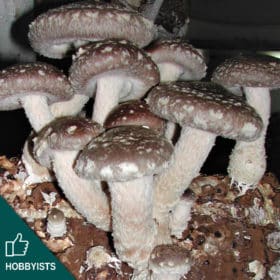
M3770 Lentinula edodes

M3770 Lentinula edodes (Shiitake)

This Shiitake strain is the absolute winner for cultivation on wood logs of oak (preferred), beech, birch or alder. All other Mycelia strains are perfect for sterilised substrates but underperform on wood logs.
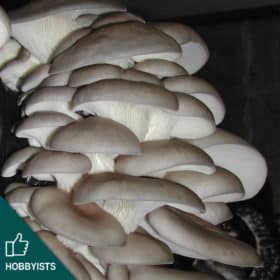
M2191 Pleurotus ostreatus

M2191 Pleurotus ostreatus (Pleurotus)

Winter Oyster is equally successful on logs. Together with M2175, they belong both to the HK- family, which is a series of hybrids, derived from the same parental pair.
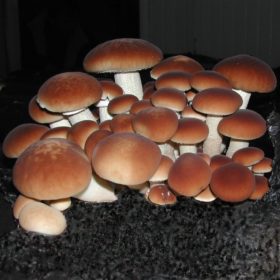
M4101 Cyclocybe aegerita (Poplar Mushroom)

The famous Italian gourmet species, easy to grow on poplar.
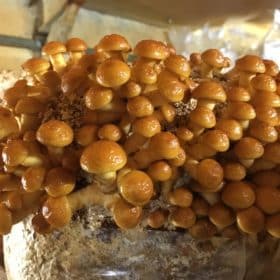
M4190 Pholiota nameko (Nameko)

A Japanese strain, colourful and tasty, on logs of deciduous trees.
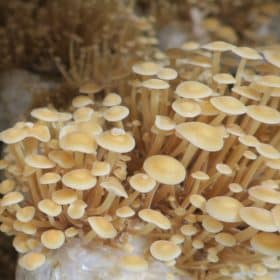
M4600 Flammulina velutipes (Enoki)

A wild strain from Western Europe, easy to grow on logs of most deciduous trees.

Share this post